


Page 65 - Demo
P. 65
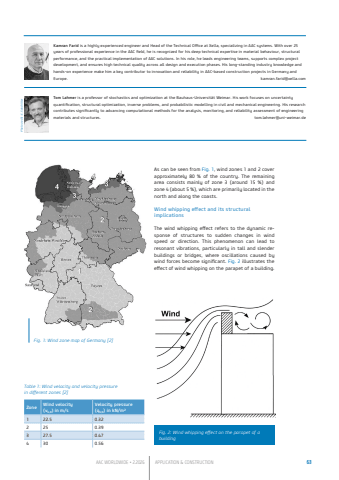
AAC WORLDWIDE %u2022 2.2026 APPLICATION & CONSTRUCTION 63As can be seen from Fig. 1, wind zones 1 and 2 cover approximately 80 % of the country. The remaining area consists mainly of zone 3 (around 15 %) and zone 4 (about 5 %), which are primarily located in the north and along the coasts.Wind whipping effect and its structural implicationsThe wind whipping effect refers to the dynamic response of structures to sudden changes in wind speed or direction. This phenomenon can lead to resonant vibrations, particularly in tall and slender buildings or bridges, where oscillations caused by wind forces become significant. Fig. 2 illustrates the effect of wind whipping on the parapet of a building.Tom Lahmer is a professor of stochastics and optimization at the Bauhaus-Universit%u00e4t Weimar. His work focuses on uncertainty quantification, structural optimization, inverse problems, and probabilistic modelling in civil and mechanical engineering. His research contributes significantly to advancing computational methods for the analysis, monitoring, and reliability assessment of engineering materials and structures. tom.lahmer@uni-weimar.deKamran Farid is a highly experienced engineer and Head of the Technical Office at Xella, specializing in AAC systems. With over 25 years of professional experience in the AAC field, he is recognized for his deep technical expertise in material behaviour, structural performance, and the practical implementation of AAC solutions. In his role, he leads engineering teams, supports complex project development, and ensures high technical quality across all design and execution phases. His long-standing industry knowledge and hands-on experience make him a key contributor to innovation and reliability in AAC-based construction projects in Germany and Europe. kamran.farid@xella.comTable%u00a01: Wind velocity and velocity pressure in different zones [2]Zone Wind velocity (vb,0) in m/sVelocity pressure (qb,0) in kN/m%u00b21 22.5 0.322 25 0.393 27.5 0.474 30 0.56Fig. 2: Wind whipping effect on the parapet of a buildingFig. 1: Wind zone map of Germany [2]Photocredit: E. Sandritter


