


Page 32 - Demo
P. 32
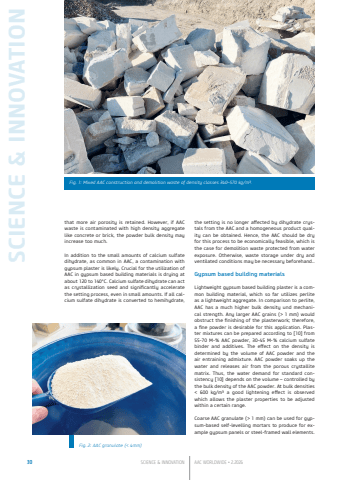
SCIENCE & INNOVATION30 SCIENCE & INNOVATION AAC WORLDWIDE %u2022 2.2026Fig. 1: Mixed AAC construction and demolition waste of density classes 340%u2013570 kg/m%u00b3.that more air porosity is retained. However, if AAC waste is contaminated with high density aggregate like concrete or brick, the powder bulk density may increase too much.In addition to the small amounts of calcium sulfate dihydrate, as common in AAC, a contamination with gypsum plaster is likely. Crucial for the utilization of AAC in gypsum based building materials is drying at about 120 to 140%u00b0C. Calcium sulfate dihydrate can act as crystallization seed and significantly accelerate the setting process, even in small amounts. If all calcium sulfate dihydrate is converted to hemihydrate, the setting is no longer affected by dihydrate crystals from the AAC and a homogeneous product quality can be obtained. Hence, the AAC should be dry for this process to be economically feasible, which is the case for demolition waste protected from water exposure. Otherwise, waste storage under dry and ventilated conditions may be necessary beforehand..Gypsum based building materialsLightweight gypsum based building plaster is a common building material, which so far utilizes perlite as a lightweight aggregate. In comparison to perlite, AAC has a much higher bulk density und mechanical strength. Any larger AAC grains (> 1 mm) would obstruct the finishing of the plasterwork; therefore, a fine powder is desirable for this application. Plaster mixtures can be prepared according to [10] from 55-70 M-% AAC powder, 30-45 M-% calcium sulfate binder and additives. The effect on the density is determined by the volume of AAC powder and the air entraining admixture. AAC powder soaks up the water and releases air from the porous crystallite matrix. Thus, the water demand for standard consistency [10] depends on the volume %u2013 controlled by the bulk density of the AAC powder. At bulk densities < 600 kg/m%u00b3 a good lightening effect is observed which allows the plaster properties to be adjusted within a certain range.Coarse AAC granulate (> 1 mm) can be used for gypsum-based self-levelling mortars to produce for example gypsum panels or steel-framed wall elements. Fig. 2: AAC granulate (< 4mm)


