


Page 26 - Demo
P. 26
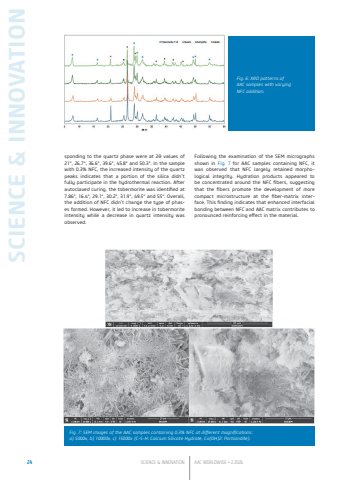
SCIENCE & INNOVATION24 SCIENCE & INNOVATION AAC WORLDWIDE %u2022 2.2026sponding to the quartz phase were at 2%u03b8 values of 21%u00b0, 26.7%u00b0, 36.6%u00b0, 39.6%u00b0, 45.8%u00b0 and 50.3%u00b0. In the sample with 0.3% NFC, the increased intensity of the quartz peaks indicates that a portion of the silica didn%u2019t fully participate in the hydrothermal reaction. After autoclaved curing, the tobermorite was identified at 7.86%u00b0, 16.4%u00b0, 29.1%u00b0, 30.2%u00b0, 31.9%u00b0, 49.5%u00b0 and 55%u00b0. Overall, the addition of NFC didn%u2019t change the type of phases formed. However, it led to increase in tobermorite intensity while a decrease in quartz intensity was observed.Following the examination of the SEM micrographs shown in Fig. 7 for AAC samples containing NFC, it was observed that NFC largely retained morphological integrity. Hydration products appeared to be concentrated around the NFC fibers, suggesting that the fibers promote the development of more compact microstructure at the fiber-matrix interface. This finding indicates that enhanced interfacial bonding between NFC and AAC matrix contributes to pronounced reinforcing effect in the material.Fig. 6: XRD patterns of AAC samples with varying NFC addition.Fig. 7: SEM images of the AAC samples containing 0.3% NFC at different magnifications: a) 5000x, b) 10000x, c) 15000x (C-S-H: Calcium Silicate Hydrate, Ca(OH)2: Portlandite).


