


Page 25 - Demo
P. 25
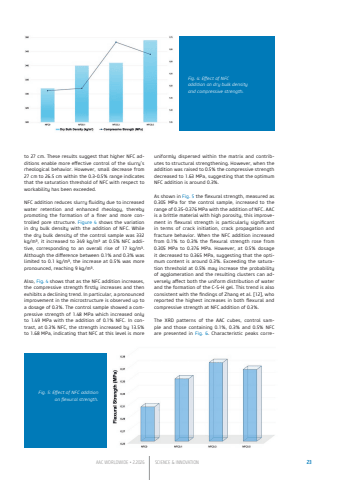
AAC WORLDWIDE %u2022 2.2026 SCIENCE & INNOVATION 23to 27 cm. These results suggest that higher NFC additions enable more effective control of the slurry%u2019s rheological behavior. However, small decrease from 27 cm to 26.5 cm within the 0.3-0.5% range indicates that the saturation threshold of NFC with respect to workability has been exceeded.NFC addition reduces slurry fluidity due to increased water retention and enhanced rheology, thereby promoting the formation of a finer and more controlled pore structure. Figure 4 shows the variation in dry bulk density with the addition of NFC. While the dry bulk density of the control sample was 332 kg/m3, it increased to 349 kg/m3 at 0.5% NFC additive, corresponding to an overall rise of 17 kg/m3. Although the difference between 0.1% and 0.3% was limited to 0.1 kg/m3, the increase at 0.5% was more pronounced, reaching 9 kg/m3.Also, Fig. 4 shows that as the NFC addition increases, the compressive strength firstly increases and then exhibits a declining trend. In particular, a pronounced improvement in the microstructure is observed up to a dosage of 0.3%. The control sample showed a compressive strength of 1.48 MPa which increased only to 1.49 MPa with the addition of 0.1% NFC. In contrast, at 0.3% NFC, the strength increased by 13.5% to 1.68 MPa, indicating that NFC at this level is more uniformly dispersed within the matrix and contributes to structural strengthening. However, when the addition was raised to 0.5% the compressive strength decreased to 1.63 MPa, suggesting that the optimum NFC addition is around 0.3%.As shown in Fig. 5 the flexural strength, measured as 0.305 MPa for the control sample, increased to the range of 0.35-0.376 MPa with the addition of NFC. AAC is a brittle material with high porosity, this improvement in flexural strength is particularly significant in terms of crack initiation, crack propagation and fracture behavior. When the NFC addition increased from 0.1% to 0.3% the flexural strength rose from 0.305 MPa to 0.376 MPa. However, at 0.5% dosage it decreased to 0.365 MPa, suggesting that the optimum content is around 0.3%. Exceeding the saturation threshold at 0.5% may increase the probability of agglomeration and the resulting clusters can adversely affect both the uniform distribution of water and the formation of the C-S-H gel. This trend is also consistent with the findings of Zhang et al. [12], who reported the highest increases in both flexural and compressive strength at NFC addition of 0.3%.The XRD patterns of the AAC cubes, control sample and those containing 0.1%, 0.3% and 0.5% NFC are presented in Fig. 6. Characteristic peaks correFig. 4: Effect of NFC addition on dry bulk density and compressive strength.Fig. 5: Effect of NFC addition on flexural strength.


