


Page 24 - Demo
P. 24
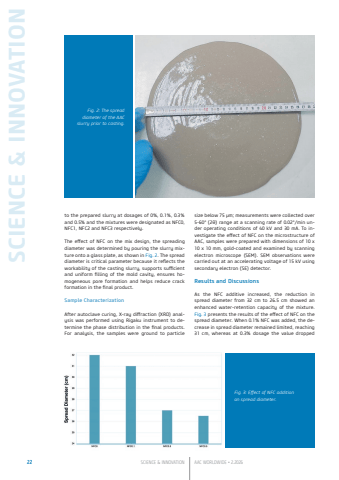
SCIENCE & INNOVATION22 SCIENCE & INNOVATION AAC WORLDWIDE %u2022 2.2026to the prepared slurry at dosages of 0%, 0.1%, 0.3% and 0.5% and the mixtures were designated as NFC0, NFC1, NFC2 and NFC3 respectively.The effect of NFC on the mix design, the spreading diameter was determined by pouring the slurry mixture onto a glass plate, as shown in Fig. 2. The spread diameter is critical parameter because it reflects the workability of the casting slurry, supports sufficient and uniform filling of the mold cavity, ensures homogeneous pore formation and helps reduce crack formation in the final product.Sample CharacterizationAfter autoclave curing, X-ray diffraction (XRD) analysis was performed using Rigaku instrument to determine the phase distribution in the final products. For analysis, the samples were ground to particle size below 75 %u00b5m; measurements were collected over 5-60%u00b0 (2%u03b8) range at a scanning rate of 0.02%u00b0/min under operating conditions of 40 kV and 30 mA. To investigate the effect of NFC on the microstructure of AAC, samples were prepared with dimensions of 10 x 10 x 10 mm, gold-coated and examined by scanning electron microscope (SEM). SEM observations were carried out at an accelerating voltage of 15 kV using secondary electron (SE) detector.Results and DiscussionsAs the NFC additive increased, the reduction in spread diameter from 32 cm to 26.5 cm showed an enhanced water-retention capacity of the mixture. Fig. 3 presents the results of the effect of NFC on the spread diameter. When 0.1% NFC was added, the decrease in spread diameter remained limited, reaching 31 cm, whereas at 0.3% dosage the value dropped Fig. 2: The spread diameter of the AAC slurry prior to casting.Fig. 3: Effect of NFC addition on spread diameter.


