


Page 35 - Demo
P. 35
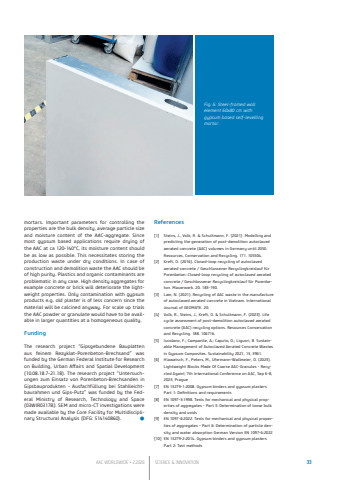
AAC WORLDWIDE %u2022 2.2026 SCIENCE & INNOVATION 33mortars. Important parameters for controlling the properties are the bulk density, average particle size and moisture content of the AAC-aggregate. Since most gypsum based applications require drying of the AAC at ca 120-140%u00b0C, its moisture content should be as low as possible. This necessitates storing the production waste under dry conditions. In case of construction and demolition waste the AAC should be of high purity. Plastics and organic contaminants are problematic in any case. High density aggregates for example concrete or brick will deteriorate the lightweight properties. Only contamination with gypsum products e.g. old plaster is of less concern since the material will be calcined anyway. For scale up trials the AAC powder or granulate would have to be available in larger quantities at a homogeneous quality.FundingThe research project %u201cGipsgebundene Bauplatten aus feinem Rezyklat-Porenbeton-Brechsand%u201d was funded by the German Federal Institute for Research on Building, Urban Affairs and Spatial Development (10.08.18.7-21.18). The research project %u201cUntersuchungen zum Einsatz von Porenbeton-Brechsanden in Gipsbauprodukten - Ausfachf%u00fcllung bei Stahlleichtbaurahmen und Gips-Putz%u201d was funded by the Federal Ministry of Research, Technology and Space (03WIR0317B). SEM and micro-CT investigations were made available by the Core Facility for Multidisciplinary Structural Analysis (DFG: 514140860). %u25cfReferences[1] Steins, J., Volk, R. & Schultmann, F. (2021). Modelling and predicting the generation of post-demolition autoclaved aerated concrete (AAC) volumes in Germany until 2050. Resources, Conservation and Recycling. 171. 105504.[2] Kreft, O. (2016). Closed-loop recycling of autoclaved aerated concrete / Geschlossener Recyclingkreislauf f%u00fcr Porenbeton: Closed-loop recycling of autoclaved aerated concrete / Geschlossener Recyclingkreislauf f%u00fcr Porenbeton. Mauerwerk. 20. 183-190.[3] Lam, N. (2021). Recycling of AAC waste in the manufacture of autoclaved aerated concrete in Vietnam. International Journal of GEOMATE. 20.[4] Volk, R., Steins, J., Kreft, O. & Schultmann, F. (2023). Life cycle assessment of post-demolition autoclaved aerated concrete (AAC) recycling options. Resources Conservation and Recycling. 188. 106716.[5] Iucolano, F.; Campanile, A.; Caputo, D.; Liguori, B. Sustainable Management of Autoclaved Aerated Concrete Wastes in Gypsum Composites. Sustainability 2021, 13, 3961.[6] Hlawatsch, F., Peters, M., Ufermann-Wallmeier, D. (2023). Lightweight Blocks Made Of Coarse AAC-Granules - Recycled Again!, 7th International Conference on AAC, Sep 6-8, 2023, Prague[7] EN 13279-1:2008. Gypsum binders and gypsum plasters Part 1: Definitions and requirements[8] EN 1097-3:1998. Tests for mechanical and physical properties of aggregates - Part 3: Determination of loose bulk density and voids[9] EN 1097-6:2022. Tests for mechanical and physical properties of aggregates - Part 6: Determination of particle density and water absorption German Version EN 1097-6:2022[10] EN 13279-2:2014. Gypsum binders and gypsum plasters Part 2: Test methodsFig. 6: Steel-framed wall element 60x80 cm with gypsum based self-levelling mortar.


