


Page 55 - Demo
P. 55
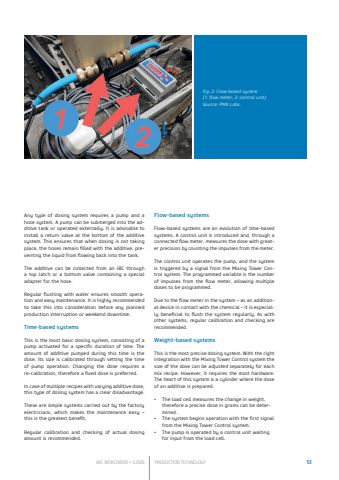
AAC WORLDWIDE %u2022 2.2026 PRODUCTION TECHNOLOGY 53Any type of dosing system requires a pump and a hose system. A pump can be submerged into the additive tank or operated externally. It is advisable to install a return valve at the bottom of the additive system. This ensures that when dosing is not taking place, the hoses remain filled with the additive, preventing the liquid from flowing back into the tank.The additive can be collected from an IBC through a top latch or a bottom valve containing a special adapter for the hose.Regular flushing with water ensures smooth operation and easy maintenance. It is highly recommended to take this into consideration before any planned production interruption or weekend downtime.Time-based systemsThis is the most basic dosing system, consisting of a pump activated for a specific duration of time. The amount of additive pumped during this time is the dose. Its size is calibrated through setting the time of pump operation. Changing the dose requires a re-calibration, therefore a fixed dose is preferred.In case of multiple recipes with varying additive dose, this type of dosing system has a clear disadvantage.These are simple systems carried out by the factory electricians, which makes the maintenance easy %u2013this is the greatest benefit.Regular calibration and checking of actual dosing amount is recommended.Flow-based systemsFlow-based systems are an evolution of time-based systems. A control unit is introduced and, through a connected flow meter, measures the dose with greater precision by counting the impulses from the meter.The control unit operates the pump, and the system is triggered by a signal from the Mixing Tower Control system. The programmed variable is the number of impulses from the flow meter, allowing multiple doses to be programmed.Due to the flow meter in the system %u2013 as an additional device in contact with the chemical %u2013 it is especially beneficial to flush the system regularly. As with other systems, regular calibration and checking are recommended.Weight-based systemsThis is the most precise dosing system. With the right integration with the Mixing Tower Control system the size of the dose can be adjusted separately for each mix recipe. However, it requires the most hardware. The heart of this system is a cylinder where the dose of an additive is prepared.%u2022 The load cell measures the change in weight, therefore a precise dose in grams can be determined.%u2022 The system begins operation with the first signal from the Mixing Tower Control system.%u2022 The pump is operated by a control unit waiting for input from the load cell.Fig. 2: Flow-based system (1: flow meter, 2: control unit). Source:%u00a0PMX%u00a0Labs.


