


Page 54 - Demo
P. 54
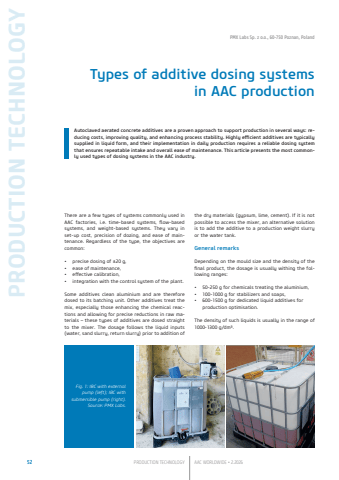
PRODUCTION TECHNOLOGY52 PRODUCTION TECHNOLOGY AAC WORLDWIDE %u2022 2.2026PMX Labs Sp. z o.o., 60-750 Poznan, PolandTypes of additive dosing systems in AAC productionAutoclaved aerated concrete additives are a proven approach to support production in several ways: re,ducing costs, improving quality, and enhancing process stability. Highly efficient additives are typically supplied in liquid form, and their implementation in daily production requires a reliable dosing system that ensures repeatable intake and overall ease of maintenance. This article presents the most common,ly used types of dosing systems in the AAC industry.There are a few types of systems commonly used in AAC factories, i.e. time-based systems, flow-based systems, and weight-based systems. They vary in set-up cost, precision of dozing, and ease of maintenance. Regardless of the type, the objectives are common:%u2022 precise dosing of %u00b120 g,%u2022 ease of maintenance,%u2022 effective calibration,%u2022 integration with the control system of the plant.Some additives clean aluminium and are therefore dosed to its batching unit. Other additives treat the mix, especially those enhancing the chemical reactions and allowing for precise reductions in raw materials %u2013 these types of additives are dosed straight to the mixer. The dosage follows the liquid inputs (water, sand slurry, return slurry) prior to addition of the dry materials (gypsum, lime, cement). If it is not possible to access the mixer, an alternative solution is to add the additive to a production weight slurry or the water tank.General remarksDepending on the mould size and the density of the final product, the dosage is usually withing the following ranges:%u2022 50-250 g for chemicals treating the aluminium,%u2022 100-1000 g for stabilizers and soaps,%u2022 600-1500 g for dedicated liquid additives for production optimisation.The density of such liquids is usually in the range of 1000-1300 g/dm%u00b3.Fig. 1: IBC with external pump (left); IBC with submersible pump (right). Source:%u00a0PMX%u00a0Labs.


