


Page 28 - Demo
P. 28
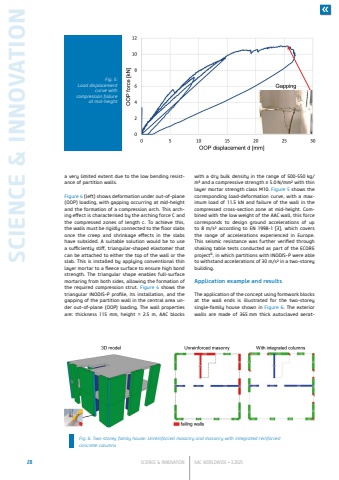
SCIENCE & INNOVATION28 SCIENCE & INNOVATION AAC WORLDWIDE %u2022 3.2025a very limited extent due to the low bending resistance of partition walls.Figure 4 (left) shows deformation under out-of-plane (OOP) loading, with gapping occurring at mid-height and the formation of a compression arch. This arching effect is characterised by the arching force C and the compressed zones of length c. To achieve this, the walls must be rigidly connected to the floor slabs once the creep and shrinkage effects in the slabs have subsided. A suitable solution would be to use a sufficiently stiff, triangular-shaped elastomer that can be attached to either the top of the wall or the slab. This is installed by applying conventional thin layer mortar to a fleece surface to ensure high bond strength. The triangular shape enables full-surface mortaring from both sides, allowing the formation of the required compression strut. Figure 4 shows the triangular INODIS-P profile, its installation, and the gapping of the partition wall in the central area under out-of-plane (OOP) loading. The wall properties are: thickness 115%u00a0 mm, height = 2.5%u00a0 m, AAC blocks with a dry bulk density in the range of 500-550 kg/m%u00b3 and a compressive strength %u2265 5.0 N/mm%u00b2 with thin layer mortar strength class M10. Figure 5 shows the corresponding load-deformation curve, with a maximum load of 11.5 kN and failure of the wall in the compressed cross-section zone at mid-height. Combined with the low weight of the AAC wall, this force corresponds to design ground accelerations of up to 8 m/s%u00b2 according to EN 1998-1 [3], which covers the range of accelerations experienced in Europe. This seismic resistance was further verified through shaking table tests conducted as part of the ECORE project4, in which partitions with INODIS-P were able to withstand accelerations of 30 m/s%u00b2 in a two-storey building.Application example and resultsThe application of the concept using formwork blocks at the wall ends is illustrated for the two-storey single-family house shown in Figure 6. The exterior walls are made of 365 mm thick autoclaved aeratFig. 5: Load displacement curve with compression failure at mid-heightFig. 6: Two-storey family house: Unreinforced masonry and masonry with integrated reinforced concrete columns


